

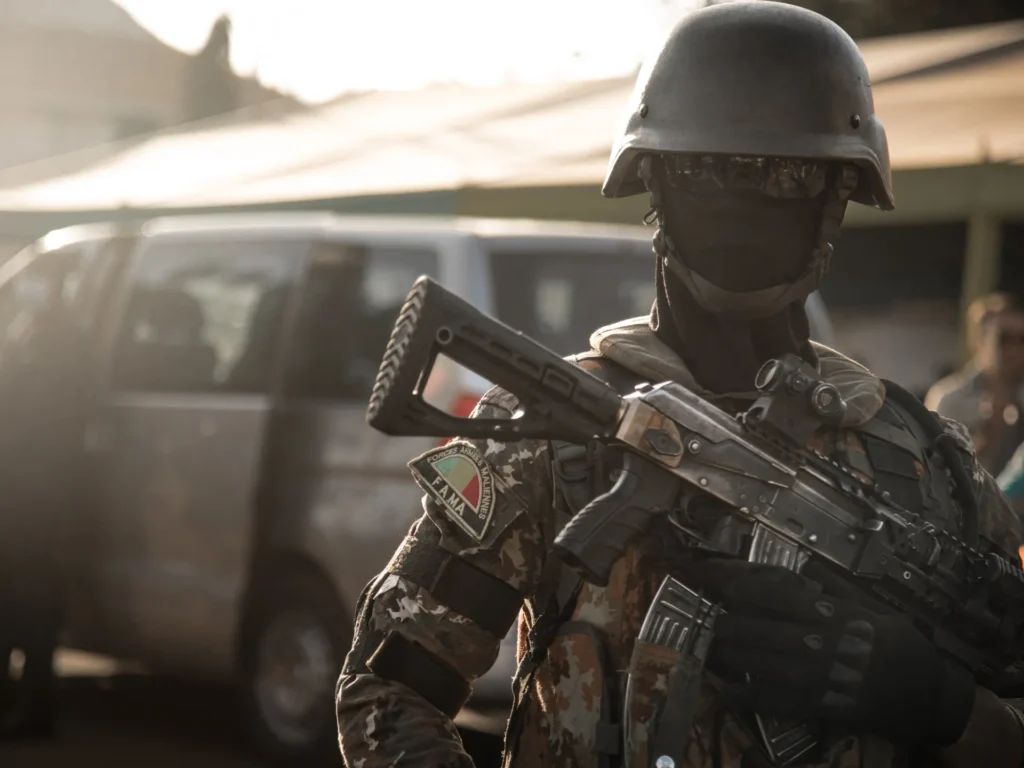
Mali’s intensifying security crisis is raising fresh concerns over the protection of civilians after Human Rights Watch reported new allegations of unlawful killings, indiscriminate drone attacks and abuses by both government-aligned forces and armed opposition groups. The findings, published on October 19, 2026, highlight the growing human cost of a conflict in which civilians are increasingly caught between military operations, Islamist insurgents and separatist fighters.
The report accuses Mali’s armed forces and their Russian government-controlled Africa Corps allies of carrying out operations that killed and wounded civilians in central and northern parts of the country. It also documents alleged torture and executions of captured Malian soldiers by fighters linked to the al-Qaeda-affiliated Group for the Support of Islam and Muslims, known as JNIM, and the Azawad Liberation Front, a separatist movement.
The findings present a troubling picture of a conflict in which violations are being reported across opposing sides, while accountability remains uncertain. Human Rights Watch has called on the African Union to increase pressure on all parties to respect international humanitarian law and take concrete steps to protect civilians.
Drone Attacks Raise Questions About Civilian Protection.
One of the report’s most serious findings concerns the use of military drones in operations that allegedly caused civilian casualties. Human Rights Watch documented a July 29 strike in Talahandak village, in the northern Kidal region, that partially destroyed a health facility. Witnesses told the organisation that the centre treated civilians and was not being used by armed groups when it was struck.

Another incident occurred on August 19 at a market in Tombonkore village in the central Bandiagara region. According to the report, the attack killed six civilians and injured at least 20 others. Witness accounts and photographs reviewed by the organisation described severe injuries among people who were at the market when the strike occurred.
The findings raise questions about whether sufficient precautions were taken to distinguish military targets from civilians and civilian infrastructure. Under international humanitarian law, parties to an armed conflict must distinguish between combatants and civilians and take feasible precautions to minimise harm to civilian populations.
Medical facilities receive specific protection under the laws of war. That protection can cease only under limited circumstances, including when a facility is used for hostile acts outside its humanitarian function and the required warning has gone unheeded. The allegations surrounding the Talahandak facility therefore warrant a thorough, independent investigation.
Five Girls Killed During a Military Operation.
The report also documents the killing of five girls aged between 10 and 13 in the Ségou region on July 12. The children were reportedly harvesting rice in a field near Niono when Malian soldiers opened fire after mistaking them for potential attackers.
According to accounts gathered by Human Rights Watch, soldiers later acknowledged that they had made a mistake and apologised to the victims’ families. The girls’ deaths illustrate the devastating consequences that can follow when military personnel fail to verify their targets before using lethal force.
The incident also raises questions about the safeguards in place during counterinsurgency operations. Even when armed forces face genuine security threats, the laws of war require them to take feasible steps to distinguish civilians from combatants. The report said that, as of mid-September, it was not aware of a government investigation into the killings or any reparations offered to the families.
For the affected communities, accountability involves more than acknowledging an error. Families need credible investigations, access to information and assurances that similar incidents will be prevented.
Captured Soldiers Also Face Alleged Abuses.
Human Rights Watch’s findings do not focus exclusively on government forces. The organisation also documented allegations that JNIM and separatist fighters tortured and executed captured Malian soldiers following an attack on a military convoy in the Gao region on July 18.
The attack occurred near Tabrichat, where the armed groups reportedly captured several soldiers. Human Rights Watch reviewed videos showing men who appeared to have surrendered before being beaten and shot by armed individuals. The organisation reported that at least 19 Malian troops were tortured and executed.
JNIM acknowledged that the killings of captured soldiers had taken place but said it had not ordered the executions. The group nevertheless declined to condemn the act or indicate that those responsible would face punishment. The Azawad Liberation Front, meanwhile, denied responsibility for executing the soldiers and said it would conduct internal checks into possible violations by its members.
The treatment of captured combatants is governed by international humanitarian law, which prohibits torture, summary executions and other forms of abuse. Once individuals are captured or have clearly surrendered, they cannot lawfully be killed simply because they were previously fighting.
The case also raises concerns for the families of missing soldiers, some of whom have reportedly struggled to obtain information from military authorities. Transparent investigations and the identification of victims are essential to establishing what happened and providing families with answers.
A Conflict Escalating Since April.
The latest allegations come amid renewed fighting that intensified after coordinated attacks on April 25, 2026. JNIM and Tuareg separatist fighters launched operations targeting military positions and other strategic locations in Mali, posing a major challenge to the military government led by General Assimi Goïta.
Government forces and their Russian allies responded with counterinsurgency operations, including airstrikes. Human Rights Watch says the response has involved abuses against civilians, including reprisals against communities suspected of supporting insurgents.
Data from the Armed Conflict Location & Event Data project cited in the report indicate that Malian forces and Africa Corps carried out 49 airstrikes between April and August 2026, resulting in 89 civilian deaths. During the same period in 2025, the organisation recorded 22 airstrikes and 44 civilian deaths. These figures indicate a sharp increase in reported civilian casualties from such operations, although they do not represent every form of violence affecting the country.
The conflict is also shaped by the relationship between armed groups and local communities. Authorities have repeatedly accused some communities of collaborating with insurgents, while rights organisations have warned that collective suspicion can expose civilians to arbitrary detention, violence and unlawful punishment.
The consequences extend beyond immediate casualties. Attacks on markets, health facilities and villages can deprive communities of essential services, disrupt livelihoods and deepen distrust between residents and security forces.
The African Union Faces Pressure to Act.
Human Rights Watch has urged the African Union’s Peace and Security Council to convene a dedicated session on civilian protection and accountability in Mali. It wants the organisation to press all parties to halt abuses, support independent investigations and report publicly on measures taken to protect civilians.
The appeal places the spotlight on the African Union’s role in responding to human-rights violations within a member state experiencing prolonged insecurity. Regional institutions face a difficult task when governments cite national security to justify military operations, while armed groups continue to threaten civilians and state authority.
However, accountability need not be incompatible with security operations. Independent investigations into unlawful killings can help identify responsible individuals, strengthen military discipline and reduce the risk of further abuses. Failing to investigate credible allegations, by contrast, can reinforce perceptions of impunity and undermine public confidence in state institutions.
Mali’s authorities did not respond to Human Rights Watch’s questions before the report was published, according to the organisation. The allegations therefore require further investigation, including a response from the government and any relevant military authorities.
Can Mali Restore Security Without Further Civilian Suffering?
Mali’s crisis demonstrates the difficulty of restoring state authority when military operations, insurgent violence and local grievances reinforce one another. The government faces serious security threats, but the protection of civilians remains a legal obligation regardless of the scale of those threats.
Armed opposition groups are equally bound by applicable rules of international humanitarian law. Their abuses cannot be excused by allegations of wrongdoing by government forces, just as violations by state personnel cannot be justified by the actions of insurgents.
For communities in central and northern Mali, the immediate priorities are protection from violence, access to medical care, reliable information about missing relatives and the restoration of basic services. Achieving these goals requires both effective security measures and credible accountability mechanisms.
The latest Human Rights Watch report adds to the evidence that Mali’s conflict is not simply a contest over territory or political power. It is also a crisis of civilian protection in which the actions of multiple armed actors are determining whether ordinary people can live safely.
The challenge now is whether Mali’s authorities, armed opposition groups and regional institutions will respond with concrete measures rather than further condemnations. Without independent investigations, meaningful accountability and stronger protections for civilians, the country risks allowing violations to become an entrenched feature of a conflict that has already exacted a devastating human cost.

Comments (0)
No comments yet — be the first to share your thoughts.