

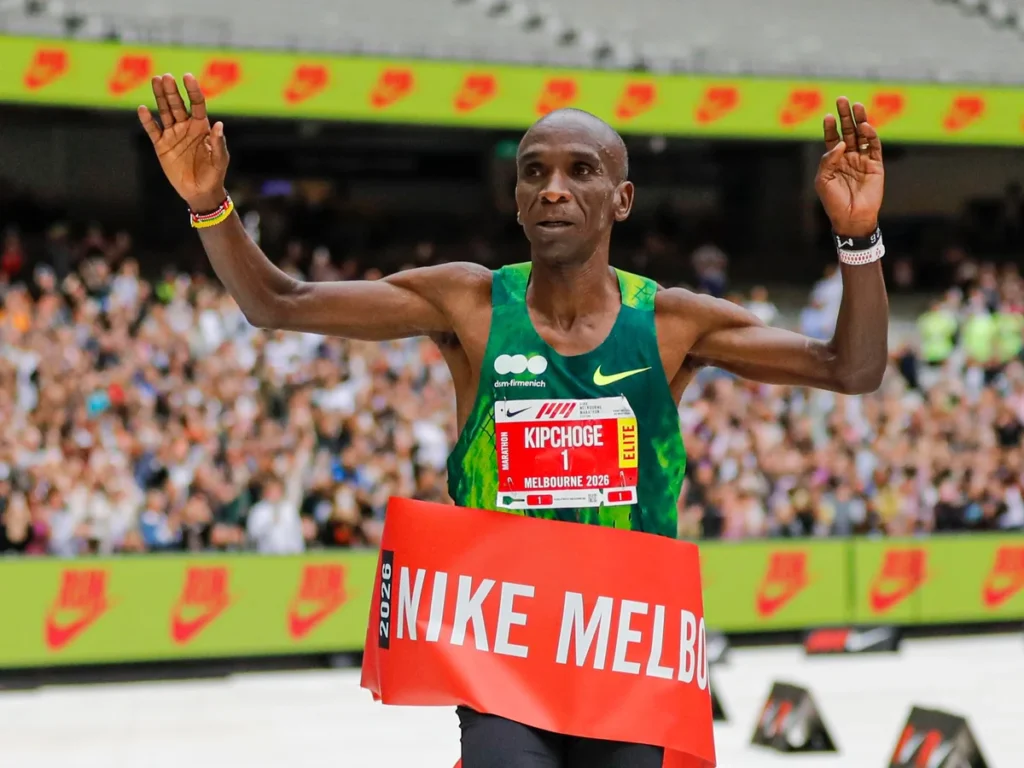
Kenyan distance-running legend Eliud Kipchoge has reportedly won the Melbourne Marathon, securing his first marathon victory in three years and adding another milestone to an extraordinary career. The result highlights the veteran runner’s continued competitiveness in a sport where success depends on exceptional endurance, precise pacing and the ability to withstand intense physical demands over 42.195 kilometres.
Kipchoge is widely regarded as one of the greatest marathon runners in history. His achievements include two Olympic marathon gold medals and a world-record performance of 2:01:09 at the Berlin Marathon in 2022. He also became the first person to run a marathon in under two hours during a special event in Vienna in 2019, although that performance was not eligible for an official world record because of the controlled conditions.
A victory in Melbourne would represent an important moment in the later stages of his career, particularly as younger runners continue to challenge the standards he helped establish.
A Champion Facing a New Stage of His Career.
For years, Kipchoge dominated major marathons through a combination of disciplined preparation, efficient running technique and remarkable consistency. His victories in Berlin and London, alongside his Olympic achievements, helped establish Kenya as a global powerhouse in long-distance running.

However, marathon careers are rarely defined by uninterrupted success. Age, recovery demands and the emergence of younger competitors can make it increasingly difficult for elite runners to maintain the form that once brought regular victories. Kipchoge’s later career has therefore involved a different challenge: finding ways to remain competitive while managing the physical demands of elite racing.
A return to the winner’s position would reinforce his ability to compete at the highest level, but it would also invite questions about the next phase of his career and how long he intends to continue racing internationally.
Kenya’s Enduring Influence in Marathon Running.
Kipchoge’s success extends beyond his personal record. He has become one of the most recognisable figures in Kenyan sport, helping sustain global attention on the country’s long-distance running tradition.
Kenyan athletes have repeatedly excelled in international road races because of a combination of individual talent, rigorous training, strong competition and established running communities. Their achievements have also inspired younger athletes to pursue careers in athletics, although access to coaching, sponsorship and professional opportunities remains uneven.
Kipchoge’s international profile has helped bring greater attention to this wider running culture. His performances have demonstrated how consistency and disciplined preparation can produce results over many years, even as the competitive landscape changes.
More Than a Marathon Victory.
For elite marathon runners, winning is only one measure of success. Race times, consistency, recovery and the ability to compete against emerging talent also shape how a performance is judged. A victory can be especially meaningful for an established champion returning to the top after a difficult period.
Kipchoge’s career has also been defined by his broader message about endurance, discipline and human potential. His sub-two-hour performance in Vienna, although unofficial for record purposes, demonstrated the possibilities of combining elite athletic ability with highly controlled preparation and pacing.
The reported Melbourne victory would add another chapter to that legacy. It would also show that, even after years at the summit of marathon running, Kipchoge remains capable of attracting attention to the sport.
What Comes Next for Kipchoge?
The next phase of Kipchoge’s career will depend on his competitive ambitions, physical condition and decisions about future races. Whether he continues targeting major marathon titles or gradually moves towards other roles in athletics, his influence on distance running is already firmly established.
For Kenya, his achievements remain a source of national sporting pride and an example for the next generation of runners. For the wider athletics community, his career offers a case study in longevity, preparation and the changing demands of elite competition.
A Melbourne triumph would not erase the challenges of maintaining elite form with age, but it would provide a

Comments (0)
No comments yet — be the first to share your thoughts.