

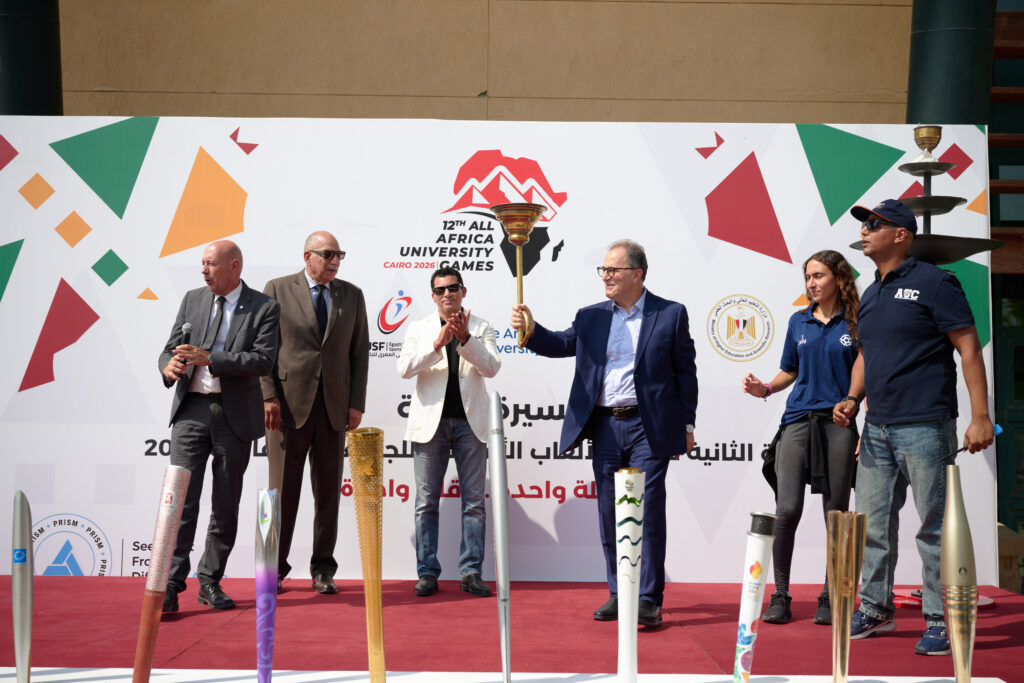
More than 2,000 athletes are expected to compete across 18 sports in Egypt.
Cairo is preparing to become the centre of African university sport as Egypt hosts the 12th All-Africa University Games from September 8 to 16, bringing together student-athletes, coaches and university officials from across the continent.
The competition programme will feature 18 major sports alongside para-sport and recreational activities. Events will be staged across several universities and sporting facilities in Cairo and Greater Cairo, giving the Egyptian capital a busy week of continental competition.
The Games are being organised by Egypt’s Ministry of Higher Education and Scientific Research, the Ministry of Youth and Sports, the Federation of Africa University Sports and the Egyptian University Sports Federation.
A platform for Africa’s next generation.
The significance of the Games extends beyond university medals.

For many young African athletes, university sport provides an important pathway between grassroots competition and elite-level sport. Competing against athletes from different countries gives students an opportunity to gain international experience while representing their universities and, in some cases, positioning themselves for future national-team careers.
The Cairo edition will feature disciplines including athletics, basketball, football, futsal, swimming, tennis, volleyball, wrestling, judo, karate, taekwondo, fencing, badminton, chess, squash, table tennis, modern pentathlon and padel. That breadth makes the Games one of the continent’s largest platforms for university sport.
Egypt puts its sporting infrastructure on display.
Hosting the competition gives Egypt an opportunity to demonstrate the country’s capacity to organise a major multi-sport continental event.
Competitions will be distributed among several venues, including university campuses and specialised sporting facilities. Athletics, judo, table tennis, karate, wrestling and taekwondo are among the events scheduled at different venues during the Games.
The approach also allows participating universities to become part of the event rather than concentrating the competition in a single stadium.
For Egypt, the Games offer another opportunity to use sport as a tool for continental engagement and to strengthen its position as a host for major African competitions.
American University in Cairo carries defending champion status.
The American University in Cairo will be among the institutions under particular attention. AUC won the overall title at the 2024 All-Africa University Games in Lagos, continuing a strong record in the competition. Its athletes will now attempt to defend that position on home soil.
The university is also serving as one of the key locations for the 2026 Games, turning its campus into an important centre of African university sport during the competition period. For the athletes, however, the medal table will only tell part of the story.
Sport meets education.
Cairo 2026 has been designed to combine sporting competition with academic and intellectual exchange. Alongside the sporting programme, the Games will include conferences, research presentations, workshops and academic discussions. A research discussion is scheduled at the British University in Egypt during the Games.
That combination reflects the wider purpose of university sport. The athletes competing in Cairo are not only sportsmen and women; they are also students preparing for professional careers.
Bringing them together creates opportunities for networking, cultural exchange and academic collaboration alongside competition.
Inclusion is part of the programme.
The Games will also include para-sport competition, giving student-athletes with disabilities an opportunity to compete on the same continental university platform.
According to Egypt’s State Information Service, Cairo 2026 will feature four para-sport categories in addition to the 18 main sports and three recreational games.
The inclusion of para-athletes adds another important dimension to the competition, particularly as African sporting institutions continue to face pressure to make major events more accessible.
A bigger opportunity for African university sport.
The importance of Cairo 2026 goes beyond the eight-day competition. African countries are experiencing rapid growth in their young populations, making universities increasingly important centres for talent development. Sport can provide a practical platform for connecting students across national, linguistic and cultural boundaries.
Events such as the FASU Games can also help universities identify talented athletes who might otherwise struggle to access international competition.
For the athletes arriving in Cairo, the immediate objective will be straightforward: win medals and represent their institutions with pride.
But for African university sport, the bigger objective is to create a sustainable pathway through which young athletes can develop while continuing their education.
Cairo sets the stage for Africa’s sporting future.
The 12th All-Africa University Games arrive at an important moment for Egyptian and continental sport.
With 18 major disciplines, para-sport competition and academic activities taking place alongside the sporting programme, Cairo 2026 is more than a university championship.
It is an opportunity to bring together a generation of young Africans who will eventually become athletes, coaches, administrators, academics and leaders within the continent’s sporting industry.
The medals will determine the winners of Cairo 2026. The relationships, experience and opportunities created during the Games could prove to be the more lasting achievement.

Comments (0)
No comments yet — be the first to share your thoughts.