

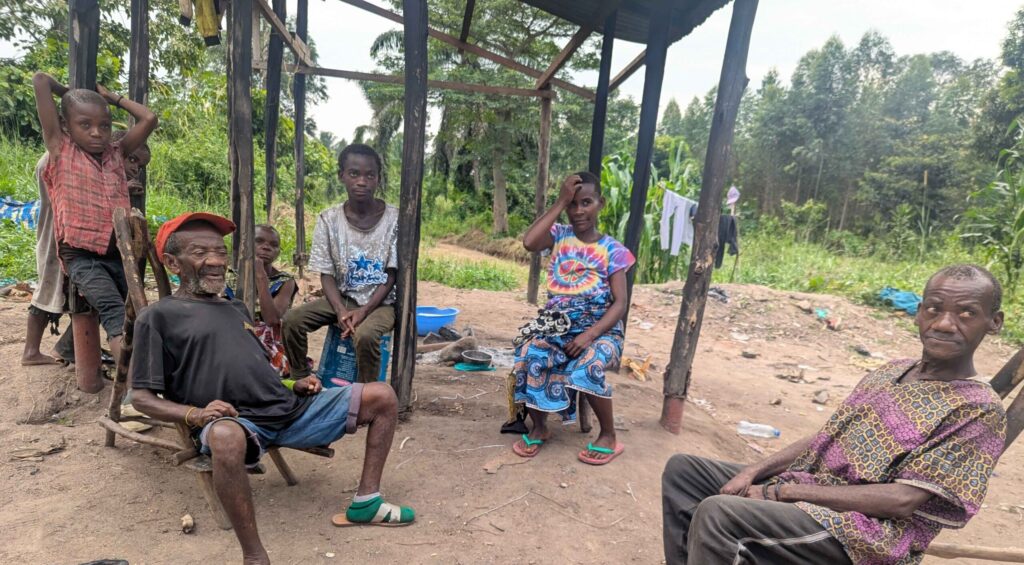
Violence has pushed families away from a way of life built around the forest.
For Indigenous Pygmy families in eastern Democratic Republic of Congo, displacement has become more than a question of finding shelter. It has meant losing access to the forests, land and traditional livelihoods that have sustained their communities for generations.
In Beni, families from the Indigenous Pygmy community are living in extremely difficult conditions after fleeing violence attributed to the Allied Democratic Forces, or ADF. Africanews reported on September 7 that the displaced families are struggling far from their traditional forest environment, where they previously depended on hunting, gathering and other activities for their survival.
The situation exposes one of the less visible consequences of the conflict in eastern DRC. Armed violence does not simply force people from one location to another. For Indigenous communities whose cultural identity and economic survival are closely connected to the land, displacement can threaten an entire way of life.
Displacement creates a second crisis.
For many displaced families, returning home is not immediately possible. Continued insecurity leaves communities dependent on humanitarian assistance while they try to survive in unfamiliar environments.

The challenge is particularly serious for Indigenous Pygmy communities because they have historically faced marginalisation and discrimination. Their displacement therefore adds another layer of vulnerability to an already difficult social situation.
Earlier reporting and research have documented how Indigenous communities in the DRC have faced loss of customary land, discrimination and displacement. Indigenous rights organisations have repeatedly warned that being separated from traditional territories can have consequences for livelihoods, culture and community identity.
The cost is not only economic.
The forest is more than a source of food and income for these communities. It is connected to their traditions, knowledge and social structures.
When families are moved into urban or semi-urban environments, they can lose access to the resources and practices around which their communities have developed. Children can also grow up increasingly disconnected from traditional knowledge.
That makes the crisis a social issue as much as a humanitarian one. Emergency assistance can provide food, shelter and medical care, but rebuilding a community’s ability to live with dignity requires more than short-term relief.
A vulnerable community caught between conflict and poverty.
The wider conflict in eastern DRC has displaced millions of people over the years, but the experience is not the same for every community.
Indigenous families can face additional barriers because of poverty, discrimination and limited access to services. Historical marginalisation means that displacement can deepen inequalities that existed long before the latest violence.
For the Pygmy communities around Beni, the immediate priority remains survival. But the longer-term question is whether displaced families will eventually have the security, land and resources needed to rebuild their lives.
Beyond humanitarian assistance.
The crisis raises a broader question about how African societies protect vulnerable communities during periods of conflict.
Humanitarian assistance is essential, but sustainable solutions must also consider land rights, cultural identity, access to education, healthcare and opportunities for economic independence.
For Indigenous communities, rebuilding should not simply mean finding a place where displaced families can stay. It should mean restoring the conditions that allow them to maintain their identity and participate fully in society.
Eastern DRC’s Indigenous Pygmy families are therefore facing two battles at once: escaping the violence that drove them from their homes and trying to preserve a way of life that displacement threatens to erase.
Their story is a reminder that the human cost of conflict cannot be measured only by the number of people killed or displaced. Sometimes, the deepest cost is the gradual loss of home, culture, livelihood and belonging.

Comments (0)
No comments yet — be the first to share your thoughts.