

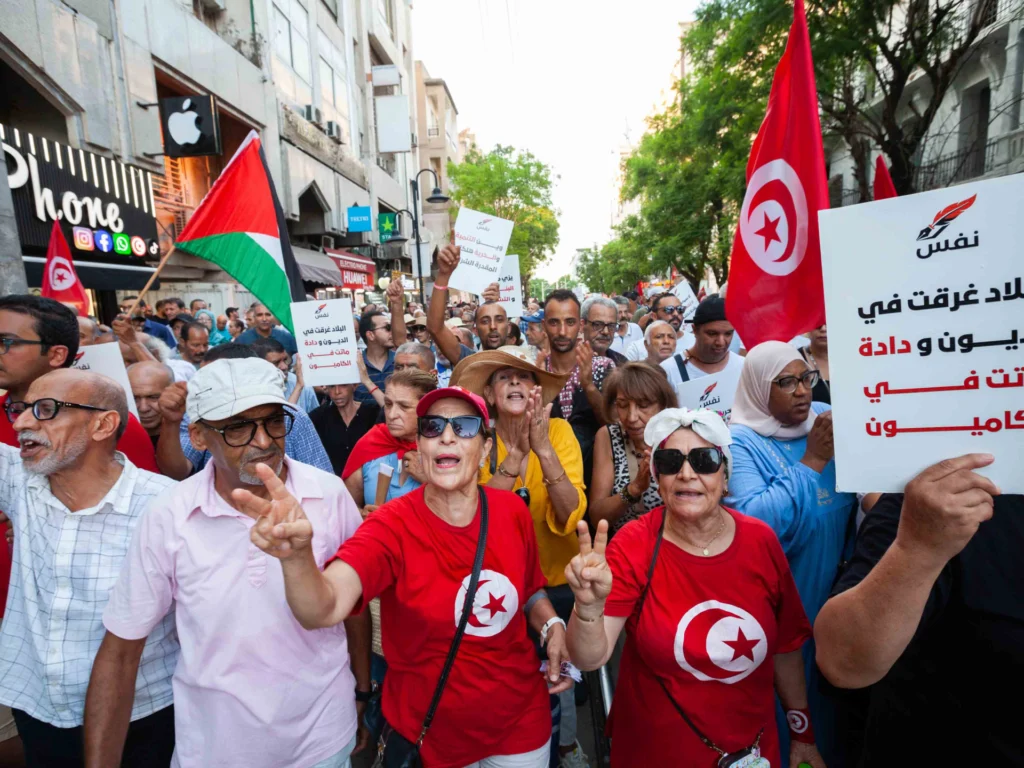
Tunisia is facing renewed international scrutiny over its democratic trajectory after Human Rights Watch released a major report documenting what it describes as an escalating crackdown on civil society, human rights organisations and activists under President Kais Saied. The 49-page report, published on September 2, 2026, argues that Tunisian authorities have increasingly used arrests, prosecutions, financial investigations, organisational suspensions and threats of dissolution to restrict civic activity, raising fresh concerns about the shrinking space for independent voices in the country.
The findings come more than five years after President Kais Saied dramatically reshaped Tunisia’s political system. Saied seized broad executive powers on July 25, 2021, suspending parliament and later introducing a new constitutional framework that significantly strengthened the presidency. Human Rights Watch says the subsequent weakening of institutional checks and balances has been accompanied by growing pressure on political opponents, journalists, activists and civil society organisations.
Human Rights Watch Says Civil Society Is Under Sustained Pressure.
According to Human Rights Watch, the latest phase of the crackdown intensified from May 2024, when authorities began systematically targeting civil society organisations and people associated with them. The organisation says at least 47 people connected to NGOs have been prosecuted, including members, employees and former employees, while at least 14 have been convicted and sentenced to prison terms. The cases documented by Human Rights Watch include people working with organisations providing assistance to refugees, asylum seekers and migrants, as well as groups involved in human rights and anti-discrimination work.
Human Rights Watch argues that the legal mechanisms being used against civil society extend well beyond conventional criminal enforcement. Authorities have relied on provisions relating to immigration, counterterrorism, money laundering and illicit enrichment to investigate or prosecute civil society actors. The organisation says these measures have created a climate of uncertainty in which NGOs face the possibility of criminal proceedings, prolonged pre-trial detention and administrative restrictions simply for carrying out activities that would normally fall within legitimate humanitarian or human rights work.

The report also highlights the use of financial investigations as a pressure mechanism. Human Rights Watch says several organisations have faced investigations requiring extensive financial and operational records, sometimes going back a decade. Such investigations, it argues, can place considerable administrative and financial pressure on organisations even when they remain legally operational.
Association Suspensions Raise Further Concerns.
Another major concern identified in the Human Rights Watch report is the suspension of civil society organisations. The organisation identified at least 20 associations that were temporarily suspended by Tunisian courts between July and October 2025 and again between April and May 2026, although it acknowledges that the precise number could be higher because official data is not publicly available.
Human Rights Watch says some organisations were allegedly suspended without receiving the formal warnings required under Tunisian law, limiting their ability to respond to accusations or correct alleged violations. Lawyers supporting suspended organisations reportedly told the organisation that around 30 associations had appealed their suspensions but had their appeals rejected. At least two organisations were facing dissolution proceedings before the Tunis Court of First Instance as of August 2026.
The issue is significant because Tunisia’s civil society became one of the most important institutional developments following the 2011 revolution. After the fall of President Zine El Abidine Ben Ali, the country adopted a new associations framework that allowed civil society organisations considerably greater freedom to form, advocate and participate in public affairs. Human Rights Watch says more than 25,000 associations were registered by February 2026, compared with roughly 9,000 before the 2011 revolution.
Kais Saied’s Government Faces Growing Criticism.
President Kais Saied and his government have repeatedly presented their political reforms as necessary to restore state authority, combat corruption and protect Tunisia’s sovereignty. The president has also accused some civil society organisations of serving foreign interests and interfering in Tunisia’s internal affairs.
Human Rights Watch, however, argues that this rhetoric has contributed to a broader climate of intimidation. The organisation says that since 2022, Saied has increasingly portrayed NGOs and civil society organisations as threats to national sovereignty and security, while authorities have simultaneously introduced legal and administrative measures that make it more difficult for independent organisations to operate.
The disagreement reflects a much larger political argument over Tunisia’s post-2011 direction. Supporters of Saied maintain that the political system established after the revolution failed to deliver effective governance and that stronger presidential authority is necessary to restore stability. Critics counter that the concentration of power has weakened democratic institutions and reduced the ability of independent organisations, journalists and opposition figures to hold the government accountable.
Migrant and Refugee Organisations Are Particularly Exposed.
Human Rights Watch’s findings also place significant attention on organisations assisting migrants, refugees and asylum seekers. The report says authorities have prosecuted workers involved in humanitarian assistance by relying on laws that criminalise facilitating or sheltering foreigners without regular immigration status.
The organisation says Tunisia’s decision in June 2024 to instruct the United Nations refugee agency, UNHCR, to suspend the processing of asylum applications has further complicated the situation. Because Tunisia does not have its own comprehensive national asylum system, Human Rights Watch argues that the suspension has left asylum seekers in legal uncertainty while increasing their vulnerability to arrest, detention and expulsion.
This dimension of the Tunisia civil society crackdown is particularly important because the country has become a major migration route toward Europe. European governments, including members of the European Union, have increasingly relied on cooperation with Tunisia to reduce irregular migration across the Mediterranean. Human rights organisations have repeatedly warned that migration-control arrangements must not come at the expense of refugee protections or fundamental rights.
Tunisia’s Democratic Legacy Is Now Under Pressure.
The Human Rights Watch report comes at a sensitive moment for Tunisia because the country remains one of the most closely watched political cases to emerge from the Arab Spring. The 2011 revolution transformed Tunisia into a symbol of democratic transition in the region, with an active network of civil society groups playing an important role in political reform, human rights monitoring and public accountability.
That legacy is now under considerable pressure. Human Rights Watch argues that the combination of prosecutions, arrests, financial investigations, organisational suspensions and proposed changes to association laws risks dismantling one of the last remaining pillars of independent public participation in Tunisia. The organisation has called on the government to release people arbitrarily detained for legitimate civil society activities, end abusive prosecutions and allow associations to operate without political interference.
The report also calls on Tunisia’s international partners, including the European Union and its member states, to publicly and privately press Tunisian authorities to release arbitrarily detained activists and NGO workers and to reverse measures that restrict legitimate civil society activity.
What the Tunisia Crackdown Could Mean for Africa.
The developments in Tunisia extend beyond the country’s domestic political debate. Across Africa, civil society organisations remain important intermediaries between governments and citizens, particularly in countries where formal political institutions are under pressure. Restrictions on NGOs, journalists and human rights organisations can therefore have wider implications for accountability, access to justice and the ability of citizens to challenge government decisions.
Tunisia’s experience is particularly significant because the country was once regarded as one of the strongest examples of democratic transition in the Arab world. The erosion of civic space therefore raises questions about whether the institutional gains associated with the 2011 revolution can survive the current concentration of executive power.
For President Kais Saied, the challenge will be to demonstrate that efforts to strengthen state authority and combat what his government describes as abuses of the political system do not permanently undermine the independent institutions and civic freedoms that emerged after 2011. For Tunisia’s civil society organisations, the immediate challenge is increasingly about survival: maintaining their ability to provide services, defend rights and participate in public life while facing growing legal and administrative pressure.

Comments (0)
No comments yet — be the first to share your thoughts.