

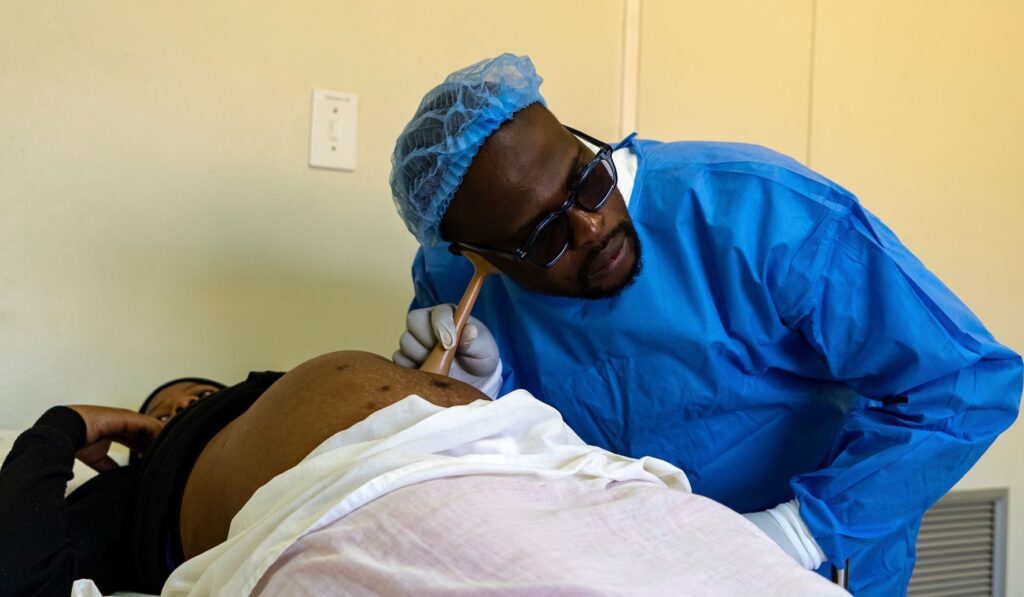
More Men Enter a Profession Traditionally Dominated by Women.
A growing number of men are becoming midwives in Lesotho as the southern African kingdom looks for new ways to reduce maternal deaths and address shortages of healthcare workers in rural communities.
One of them is Ntlhane Sehloho, a male midwife who has worked in the profession for about two decades. He travels for up to three hours across mountainous roads to reach the Mpharane Health Centre in Mohale’s Hoek, where he provides prenatal and childbirth care.
About 300 Male Midwives.
Lesotho is estimated to have around 300 male midwives, although the government does not officially record the profession’s numbers by gender. Their growing presence reflects an effort to expand access to skilled birth attendants, particularly in rural areas where healthcare facilities and personnel remain limited.
For Sehloho, the decision to enter midwifery was influenced by what he witnessed growing up. He saw women in his rural community travelling long distances for maternity care, with some giving birth at home because they could not reach health facilities in time.

Health authorities subsequently encouraged male nurses to undergo midwifery training as part of efforts to strengthen maternal healthcare.
Breaking Cultural Barriers.
Midwifery has traditionally been viewed as women’s work in Lesotho, meaning some expectant mothers remain uncomfortable receiving intimate maternity care from men. However, acceptance is gradually increasing as more male midwives become part of the country’s healthcare system.
Lesotho’s health authorities argue that gender should not determine who provides quality maternity care. Women who are uncomfortable with male midwives can request female caregivers where circumstances allow.
Some women have also reported positive experiences, saying male midwives provide the same level of professional care as their female counterparts.
Maternal Mortality Remains a Major Challenge.
The issue has a serious public-health dimension. The United Nations estimates that around 530 women die for every 100,000 live births in Lesotho, significantly higher than the global average of about 200.
At the same time, progress has been recorded in expanding access to skilled healthcare. UNICEF data cited by AP indicate that 92% of births in Lesotho are now attended by trained healthcare providers.
The increasing involvement of male midwives is therefore part of a broader effort to ensure that women, particularly those in remote communities, have access to professional care before, during and after childbirth.
A Small Change With a Bigger Meaning.
The experience of Lesotho reflects a wider challenge across Africa, where maternal mortality remains disproportionately high and healthcare systems continue to face shortages of trained personnel. Globally, men account for less than 1% of midwives, according to World Health Organization figures cited by AP.
For Lesotho, however, the growing acceptance of male midwives shows how traditional expectations can change when communities are confronted with urgent healthcare needs.
The rise of male midwives is not simply about men entering a traditionally female profession. It is about expanding the pool of skilled professionals available to mothers and babies. In a country where distance, healthcare shortages and high maternal mortality remain serious challenges, Lesotho is increasingly demonstrating that saving lives may require breaking old assumptions about who can provide care.

Comments (0)
No comments yet — be the first to share your thoughts.