

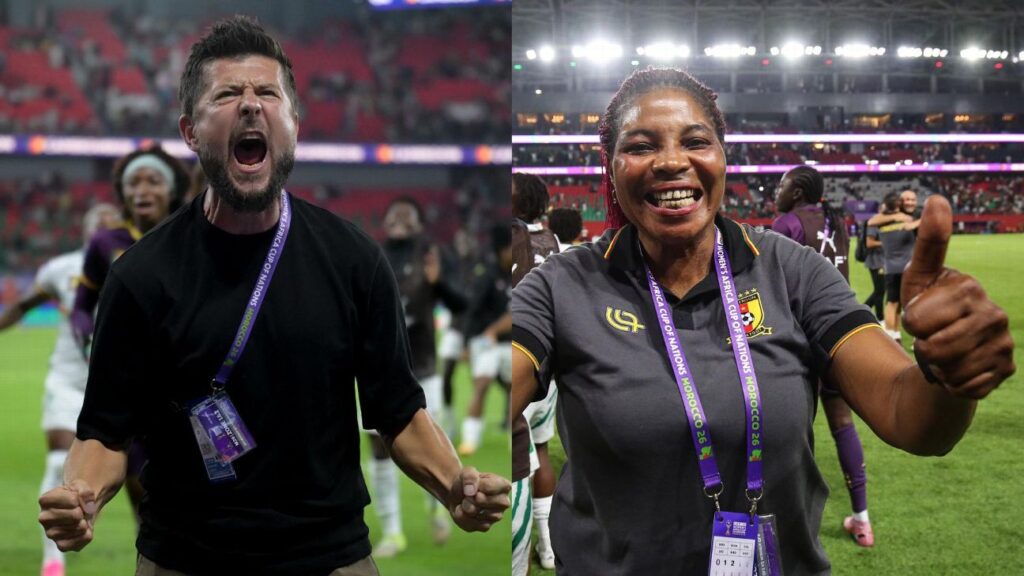
Cameroon’s Historic WAFCON Triumph Has Sparked a Debate Over Who Really Built the Champions.
Cameroon’s maiden Women’s Africa Cup of Nations title should have been a straightforward celebration of a historic achievement. Instead, the triumph has opened a more complicated conversation about leadership, expertise and recognition within African football. On 16 August 2026, the Indomitable Lionesses defeated Malawi 3–0 in Rabat to win the WAFCON for the first time in the country’s history. At the centre of the achievement was Valentine Nguele, who became the first woman to lead Cameroon’s senior women’s national team to continental glory. Yet as the celebrations continued, attention also turned to Dimitri Lipoff, the French technical coordinator whose contribution to the rapid construction of the championship-winning team has generated considerable discussion.
The temptation is to turn the story into a competition between the two: Nguele as the local coach who stood on the touchline and Lipoff as the international expert who supposedly built the team from behind the scenes. But that interpretation risks oversimplifying one of the most remarkable coaching projects in recent Cameroonian football. The more uncomfortable and interesting question is not whether one replaced the other, but whether the public narrative is already beginning to give greater weight to foreign technical expertise while overlooking the achievement of the Cameroonian woman who officially led the team to its first continental title.
A Team Built in a Matter of Weeks.
The circumstances surrounding Cameroon’s campaign make the achievement even more extraordinary. The country entered the expanded 2026 WAFCON as a late replacement after failing to qualify through the conventional route, meaning the new technical team had to build a competitive squad against the clock. There was no luxury of a long preparation cycle, no extended sequence of competitive matches and little room for experimentation.
FECAFOOT president Samuel Eto’o appointed Valentine Nguele as head coach and selector in June, while Dimitri Lipoff was brought into the structure as technical coordinator. The timing left the staff with roughly six weeks to identify players, assess domestic and diaspora talent, establish a tactical framework and develop the kind of collective mentality required to compete against teams that had spent considerably longer preparing for the tournament.

That context is essential when assessing Lipoff’s contribution. His international experience and background in women’s football gave the project an important technical dimension at a moment when Cameroon needed to move quickly. His experience with clubs and teams including Paris Saint-Germain, Olympique Lyonnais, Wuhan Jianghan, Napoli Femminile and Al Ahly Women gave him knowledge of different football environments and player-development systems. The speed with which Cameroon assembled a competitive squad suggests that his role was far from ceremonial.
But recognising that contribution does not automatically make Nguele a figurehead.
Valentine Nguele Was Entrusted With the Team.
Nguele’s appointment carried both sporting and historical significance. She was not brought into the technical staff as a symbolic presence after the important decisions had already been made. She was appointed head coach and selector, giving her formal responsibility for the team’s sporting direction.
More importantly, she brought something that no foreign résumé could replicate: an understanding of Cameroonian football and the players themselves. As a former Indomitable Lioness and a coach who had worked within the domestic women’s game, Nguele understood the environment in which the team had been assembled. She knew the realities facing local players, the expectations surrounding the national team and the cultural dynamics that can influence an international dressing room.
She also introduced what she described as a “Warrior Mindset”, placing emphasis on discipline, unity and mental strength. Those ideas became particularly important as Cameroon progressed through the knockout stages, where the margin between success and failure became increasingly narrow.
Lipoff’s Contribution Cannot Be Dismissed Either.
At the same time, it would be unfair to minimise what Lipoff brought to the project simply because Nguele was the official head coach.
The Frenchman arrived with a background that exposed him to several of the world’s more developed women’s football structures. That experience was particularly valuable for a Cameroon side being assembled under extraordinary time pressure. Recruitment, player assessment, tactical organisation and preparation all had to happen quickly.
The task was not simply to select the best available players. The technical team had to determine which players could function together, identify the strengths of the diaspora contingent, integrate domestic talent and create a system capable of competing immediately.
Lipoff’s experience could therefore have made a significant difference. The public record and statements from the coaching staff suggest that he was an important part of that process.
The mistake would be to confuse importance with ultimate authority.
The Tournament Offered a Test of Nguele’s Leadership.
Whatever happened during preparation, Cameroon’s campaign was ultimately decided in the knockout stages.
The Lionesses eliminated Nigeria in the quarter-finals, overcame Morocco in a dramatic semi-final penalty shootout and then defeated Malawi 3–0 in the final. Those were three very different challenges, requiring the team to demonstrate tactical discipline, resilience and emotional control.
The victory over Nigeria was particularly significant because the Super Falcons entered the tournament with a long history of dominance in African women’s football. Eliminating them required Cameroon to execute under immense pressure. Against Morocco, the challenge was even more complicated because Cameroon had to withstand the emotional intensity of facing the host nation before eventually prevailing on penalties.
Then came the final, where Cameroon produced its most complete performance of the tournament.
These moments matter when assessing Nguele’s role. A head coach’s responsibility does not end with recruitment or training-ground preparation. Managing players, making decisions during matches, maintaining confidence and responding to the psychological demands of knockout football are central parts of the job.
Nguele Herself Has Refused to Turn the Success Into a Personal Victory.
One of the most revealing aspects of the debate is Nguele’s own attitude towards Lipoff.
Following Cameroon’s victories in the knockout stages, she publicly acknowledged the French coach’s international experience and spoke about the complementary nature of the technical staff. Rather than presenting herself as the sole architect, she recognised that different members of the team brought different forms of expertise.
That approach is important because it offers a more credible explanation of Cameroon’s success.
A head coach does not have to be the most experienced person in every area. In fact, good leadership often means recognising where others possess greater expertise and allowing them to contribute. Nguele’s willingness to acknowledge Lipoff does not diminish her authority. It could instead demonstrate confidence in her own position.
The problem arises only when that acknowledgment is interpreted as evidence that she was not really in charge.
Where the “Front” Narrative Becomes Problematic.
There is a legitimate question about the visibility of Lipoff during the tournament. His international experience made him an obvious figure for media attention, and his role in the team’s rapid preparation naturally attracted interest.
That visibility, however, should not automatically be converted into a claim that he was secretly running the team.
There is currently no credible evidence establishing that Nguele was merely a front for Lipoff. The official structure identified her as head coach and selector and him as technical coordinator. Neither has publicly claimed the other’s role.
What the evidence does demonstrate is that Lipoff had significant influence over the technical project and that Nguele had responsibility for leading the team.
Those two statements can exist at the same time.
The Debate Reflects a Bigger Problem in African Football.
The controversy nevertheless raises an important issue about how African football evaluates local and foreign expertise.
African coaches frequently operate under an uneven standard of scrutiny. When a foreign coach arrives with experience at European clubs, his qualifications can immediately be interpreted as evidence of superior technical knowledge. African coaches, meanwhile, are sometimes treated as beneficiaries of foreign expertise even when they hold the official authority and understand the players and environment better.
Cameroon’s WAFCON victory should encourage a more balanced conversation.
International expertise can be valuable without automatically becoming superior. Local expertise can be essential without pretending that outside knowledge has no value.
The success of Nguele and Lipoff may actually demonstrate that African football does not have to choose between the two.
The Real Achievement Was the Combination.
Cameroon’s situation was unusual enough that cooperation may have been essential. Nguele brought knowledge of the domestic game, the players and the cultural environment. Lipoff brought international experience and technical exposure. The rest of the coaching staff contributed specialised expertise.
The players then had to turn that combination into football.
That is where the title was ultimately won.
A coach can design a system, but players must believe in it. A technical coordinator can help assemble a squad, but the group must develop trust. A head coach can establish a mentality, but the players must carry that mentality onto the pitch.
Cameroon managed to make those pieces work in an extraordinarily short period.
Nguele’s Place in History Should Not Be Negotiable.
There is also a symbolic dimension that cannot be ignored.
Valentine Nguele is now permanently connected to one of the biggest milestones in Cameroonian women’s football. She is the first woman to lead the Indomitable Lionesses to a WAFCON title.
That achievement has importance beyond the 2026 tournament. It provides a reference point for women seeking coaching careers in Cameroon and across Africa. It challenges the idea that senior women’s national teams must be led by men or foreign coaches to succeed.
Credit to Lipoff does not change that.
If anything, his contribution should strengthen rather than weaken the story: a Cameroonian woman was entrusted with leadership while an experienced international specialist worked alongside her, and together they delivered the country’s first WAFCON championship.
The Trophy Belongs to a Team, Not a Single Mastermind.
Football’s obsession with finding a single mastermind often makes complex achievements easier to sell but less accurate to understand.
Cameroon’s WAFCON triumph does not need one person to explain it.
Lipoff deserves recognition for helping close an enormous preparation gap and bringing international experience to a team assembled under difficult circumstances. Nguele deserves recognition for leading the group, establishing its mentality and carrying the responsibility of the head coach. The players deserve the greatest credit for executing when the pressure became enormous.
The technical staff, federation and support personnel also played their parts.
So, was Valentine Nguele just the front for Dimitri Lipoff’s masterclass? The available evidence does not support that conclusion. What it points to instead is a partnership in which a Cameroonian head coach and an international technical coordinator brought different strengths to the same project.
The more important debate is therefore not about who deserves to own the trophy. It is about whether Cameroon can learn from this structure and build something sustainable from it.
Because the greatest danger now would be to spend so much time arguing about who deserves the credit that the country misses the bigger lesson.
Cameroon has discovered that local leadership and international expertise do not have to compete. They can complement each other. And if the Lionesses’ historic WAFCON triumph is to become the beginning of a new era rather than a one-off miracle, that may be the partnership worth preserving.

Comments (0)
No comments yet — be the first to share your thoughts.