

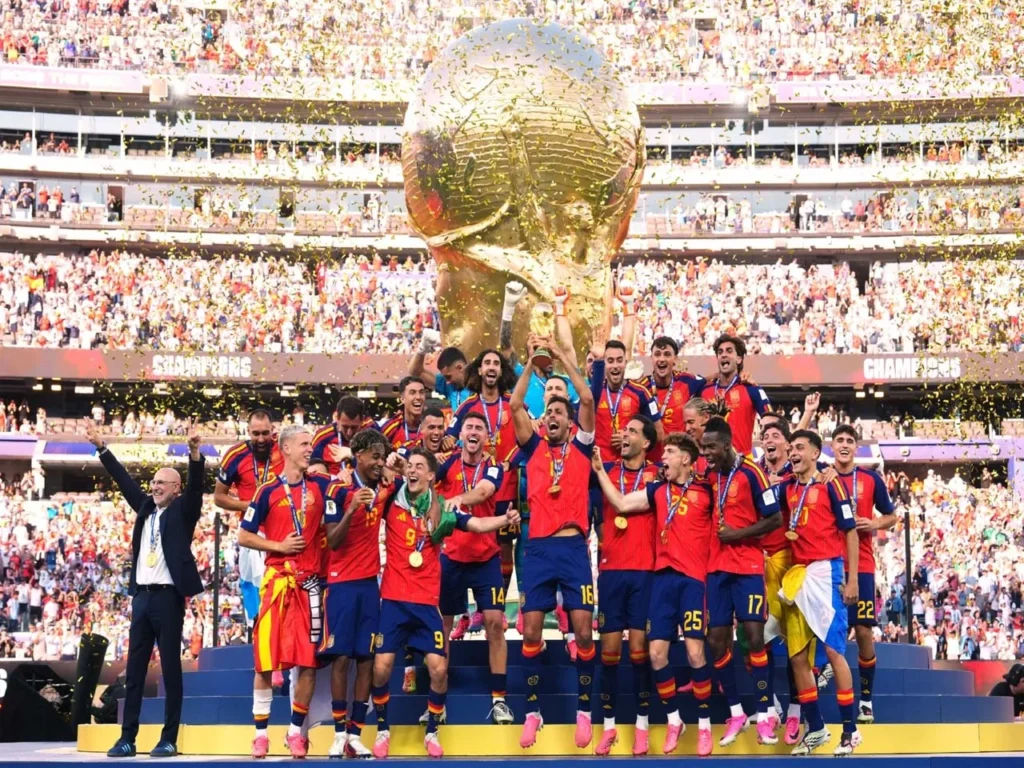
Spain has defeated Argentina 1-0 in the 2026 FIFA World Cup final, winning its second world title after a dramatic extra time battle that may have marked the end of Lionel Messi’s World Cup journey. The final, played on 19 July 2026 at the New York New Jersey Stadium, was decided by Ferran Torres’ 106th minute goal, giving coach Luis de la Fuente another major international trophy after Spain’s European Championship success in 2024.
The match was expected to be a celebration of football’s greatest modern rivalry, with Argentina defending their title and Spain representing a new generation led by young stars such as Lamine Yamal. Instead, it became a tactical battle defined by patience, defensive discipline and one decisive moment that changed football history.
Spain’s Patience Delivers a Historic Victory
Spain entered the final as one of the most complete teams of the tournament, combining experienced players with a generation of young talents. Under Luis de la Fuente, the team moved away from the traditional possession heavy style that defined Spain’s golden era between 2008 and 2012 and developed a more balanced approach built around intensity, pressing and defensive organisation.
Against Argentina, Spain controlled much of the match. The team dominated possession and created more attacking opportunities, but struggled to break down Argentina’s defensive structure. Goalkeeper Emiliano Martínez, who played a crucial role in Argentina’s 2022 World Cup triumph, kept his team alive with several important saves.

The breakthrough finally arrived in extra time. Substitute Nico Williams played a key role by creating the opportunity that allowed Ferran Torres to score the winning goal in the 106th minute. The Barcelona forward became an unexpected hero of the biggest match in world football.
For Spain, the victory represents another golden period in national team history. After winning Euro 2024, the country has now added the World Cup trophy, confirming its return as one of football’s dominant nations.
Argentina’s Defensive Strategy Falls Short
Argentina arrived at the final with confidence and experience. The team had won the 2022 FIFA World Cup in Qatar and entered the tournament hoping to give Lionel Messi another historic achievement.
However, Argentina struggled to create attacking opportunities against Spain’s organised defence.
Led by coach Lionel Scaloni, Argentina adopted a cautious approach designed to limit Spain’s attacking threats. The strategy worked for much of the match, but the team was unable to produce enough danger going forward.
Argentina created moments of resistance but lacked the attacking sharpness needed to defeat Spain. Their hopes disappeared when Ferran Torres found the winning goal in extra time.
The disappointment was increased during the final stages of the match when Enzo Fernández received a red card, leaving Argentina to finish the game with ten players.
The Messi Era Moves Toward Its Final Chapter
Beyond the result, the final carried enormous emotional significance because it may have been Lionel Messi’s last appearance at a FIFA World Cup.
At 39 years old, Messi entered the tournament knowing another opportunity to win football’s biggest trophy would be extremely unlikely. His 2022 World Cup victory had already completed one of the greatest careers in football history, but another title would have created an even more remarkable ending.
Messi’s journey with Argentina transformed dramatically over two decades. Earlier in his international career, he faced criticism for failing to replicate his Barcelona success with the national team. However, his Copa América victory in 2021 and World Cup triumph in 2022 changed his legacy forever.
For Argentine supporters, Sunday’s defeat was painful, but Messi’s contribution to the national team remains unquestionable.
His career with Argentina will be remembered not only for the trophies but also for the emotional connection he built with millions of fans who waited years to see him succeed internationally.
Lamine Yamal and Spain’s New Generation
While Messi represented the final chapter of one era, Lamine Yamal represented the beginning of another.
The Spanish teenager has become one of football’s biggest young stars after breaking records at both club and international level. His presence in a World Cup final against a player who inspired generations of footballers symbolised the changing landscape of the sport.
Spain’s success was not built only around Yamal. Players such as Rodri, Dani Olmo, Mikel Oyarzabal and Nico Williams demonstrated the depth of talent available to the national team.
This generation suggests that Spain’s success may not be a short term achievement but the beginning of another sustained period of competitiveness.
The country’s football system continues to produce technically gifted players while adapting to the modern demands of international football.
A Final That Reflected Football’s Changing Balance
The Spain versus Argentina final represented more than a contest between two teams. It reflected a wider shift happening in world football.
Argentina entered the match as defending champions, built around the experience of Messi and a generation that had already delivered historic success.
Spain represented youth, tactical evolution and a new generation of players ready to take responsibility on the biggest stage.
The result showed that international football is no longer controlled only by individual brilliance. Modern champions require tactical flexibility, squad depth and the ability to perform under extreme pressure.
Spain’s victory demonstrated the importance of building a complete football system rather than depending on one or two exceptional players.
What This Means for Global Football
Spain’s victory strengthens its position among football’s historic nations. With two World Cup titles, multiple European Championships and a new generation of talent emerging, Spain has created another foundation for future success.
For Argentina, the defeat does not erase the achievements of the Messi era. Winning the 2022 World Cup restored national pride and delivered one of the greatest sporting moments in Argentine history.
The next challenge for Argentina will be rebuilding after the departure of some experienced leaders while maintaining the competitive identity developed under Lionel Scaloni.
The Bigger Picture
The Spain and Argentina final will be remembered as a meeting between football’s past and future.
Lionel Messi’s Argentina represented experience, resilience and the final chapter of one of the greatest careers ever seen in sport.
Spain represented renewal, youth and the arrival of a new generation.
In the end, one goal separated them.
Ferran Torres’ strike gave Spain another World Cup trophy, but the bigger story was the changing face of football itself.
The Messi era may be approaching its conclusion, but the game he helped transform continues to produce new heroes.

Comments (0)
No comments yet — be the first to share your thoughts.