
For decades, Kenyan politics was shaped by powerful personalities, traditional political parties and long-established alliances.
Presidential elections were often defined by ethnic coalitions, political dynasties and negotiations among senior leaders.
But something changed.
A new generation entered the political conversation.

They did not wait for party structures.
They did not rely on traditional political rallies.
They organised online, debated policies, challenged leaders and forced the country to confront a question that many African governments can no longer ignore:
What happens when a generation that grew up with the internet demands a different kind of politics?
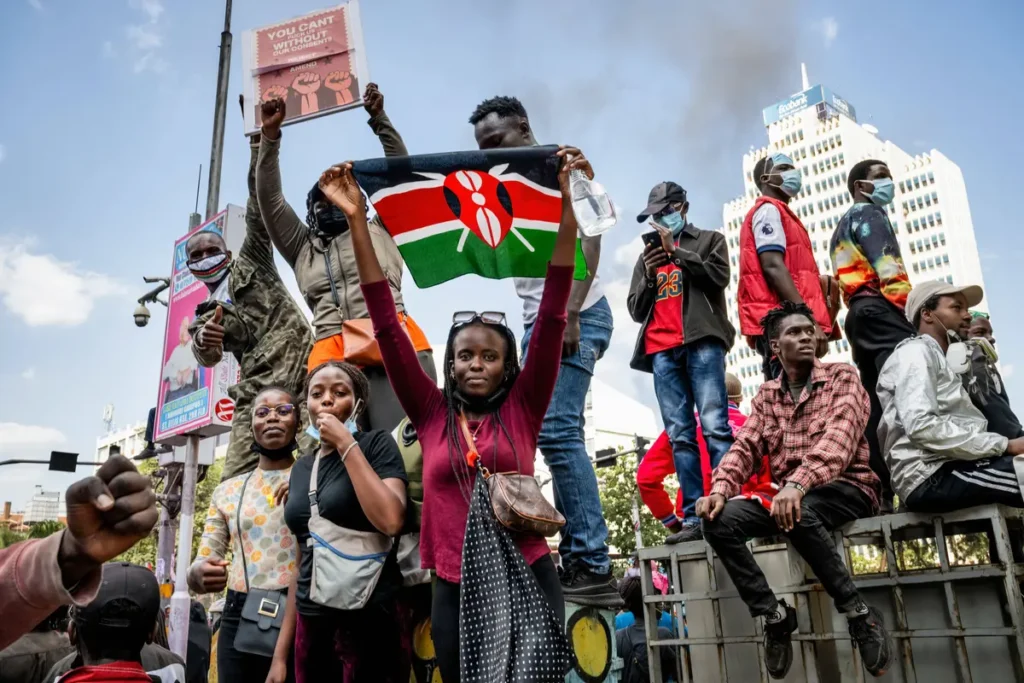
Kenya’s Gen Z movement represents more than a protest against a government decision.
It represents a broader transformation in African politics.
A younger generation is demanding accountability, transparency and economic opportunity—not simply political promises.
The Finance Bill That Sparked a Movement
The turning point came in 2024 when Kenya’s government introduced the Finance Bill, a proposed package of tax increases aimed at raising additional revenue.
The government argued that increased taxation was necessary to reduce public debt, fund essential services and strengthen national finances.
However, many young Kenyans saw the proposals differently.
For a generation already facing unemployment, high living costs and limited economic opportunities, the new taxes felt like another burden placed on citizens who were already struggling.
The debate quickly moved beyond taxation.
It became a conversation about trust.
Many young Kenyans asked:
Why should citizens pay more taxes if they do not see improvements in public services?
Why should young people sacrifice when corruption remains a concern?
Why should a generation facing economic uncertainty continue accepting political promises without results?
A Digital Generation Changed the Rules
The most remarkable aspect of Kenya’s youth movement was how quickly it developed.
Unlike previous political movements that depended on political parties, unions or organised groups, Gen Z mobilisation largely happened through digital platforms.
TikTok, X (formerly Twitter), Instagram and WhatsApp became spaces for political education, debate and coordination.
Young Kenyans explained complex sections of the Finance Bill through videos and online discussions.
They shared information about parliamentary votes.
They encouraged peaceful demonstrations.
They challenged politicians directly.
The movement demonstrated a reality that governments across Africa are still learning:
Digital platforms have transformed citizens from passive audiences into active participants.
Kenya’s Youth Reality
The frustration behind the protests cannot be separated from Kenya’s economic realities.
Kenya has one of Africa’s youngest populations.
More than 75% of the population is below the age of 35, according to national demographic estimates.
This should represent a major economic advantage.
However, many young Kenyans face significant barriers:
- Limited formal employment opportunities.
- Rising living costs.
- High competition for jobs.
- Expensive education.
- Difficulty accessing capital for businesses.
The International Labour Organization has repeatedly highlighted youth employment as one of Africa’s biggest economic challenges.
For many young Africans, the problem is not a lack of ambition.
It is a lack of opportunity.
A Generation That Rejects Traditional Politics
Kenya’s political history has traditionally been dominated by established figures and party structures.
Leaders such as Jomo Kenyatta, Daniel arap Moi, Mwai Kibaki, Uhuru Kenyatta and Raila Odinga shaped political life for decades.
Many young Kenyans grew up watching the same political figures return during every election cycle.
Gen Z’s frustration is partly a rejection of this political culture.
They are less interested in political loyalty based on identity or historical alliances.
They are asking more practical questions:
Who will create jobs?
Who will improve healthcare?
Who will reduce corruption?
Who will make life affordable?
This represents a significant shift in political expectations.
President William Ruto’s Challenge
President William Ruto came to power in 2022 after campaigning on a platform focused on ordinary citizens, particularly Kenya’s “hustlers”—small business owners, workers and young entrepreneurs.
His message resonated with many voters who felt excluded from traditional political systems.
However, governing has proven more complicated.
Ruto’s administration has argued that difficult economic decisions are necessary to stabilise Kenya’s finances.
The government has pointed to high public debt levels and the need to increase domestic revenue.
Supporters argue that reform requires sacrifice.
Critics argue that citizens are being asked to sacrifice before seeing meaningful improvements.
The Gen Z protests exposed this gap between government economic reasoning and public experience.
The Rise of Issue-Based Politics
One of the most important aspects of Kenya’s youth movement is that it was largely issue-driven rather than party-driven.
Young protesters did not organise around a traditional political ideology.
They organised around specific concerns:
- Taxes.
- Accountability.
- Cost of living.
- Governance.
This could represent a new direction for African politics.
For decades, elections across the continent have often been shaped by identity, regional interests and party loyalty.
A younger generation may increasingly judge governments based on performance.
That could fundamentally change political competition.
But Can Online Movements Create Long-Term Change?
The biggest question facing Kenya’s Gen Z movement is whether digital activism can translate into lasting political influence.
Social media can mobilise millions quickly.
But governing requires institutions, organisation and long-term strategy.
Successful political change usually requires:
- Policy expertise.
- Leadership structures.
- Negotiation skills.
- Institutional participation.
Many youth movements across the world have faced this challenge.
Mobilisation is powerful.
Building alternatives is harder.
Africa’s Wider Youth Awakening
Kenya’s experience reflects a broader continental trend.
Across Africa, young citizens are increasingly challenging governments.
In Nigeria, young people have protested economic hardship.
In Senegal, youth frustration contributed to political change and the rise of new political movements.
In South Africa, unemployment has become one of the biggest political issues.
Across the continent, young Africans are connected by similar concerns:
Jobs.
Opportunity.
Affordable living.
Fair governance.
The details differ from country to country, but the underlying message is similar.
Young Africans want governments that deliver.
The Role of Technology in African Democracy
Kenya’s Gen Z movement also highlights the growing importance of technology in democracy.
Digital platforms can:
- Increase political awareness.
- Expose corruption.
- Encourage participation.
- Give citizens direct access to information.
However, technology also creates challenges.
Misinformation can spread quickly.
Online debates can become polarised.
Governments may attempt to restrict digital spaces.
The future of African democracy will increasingly depend on how societies balance digital freedom with responsible information systems.
What Governments Must Understand
The biggest lesson from Kenya is not simply about protests.
It is about expectations.
Young Africans are not necessarily rejecting government.
They are rejecting a style of governance where citizens are expected to wait indefinitely for results.
Governments that want stability must create meaningful opportunities.
This means:
- Expanding employment.
- Supporting entrepreneurship.
- Improving education.
- Reducing corruption.
- Creating transparent institutions.
Suppressing youth frustration does not solve the underlying problem.
Addressing it does.
The Verdict
Kenya’s Gen Z movement is more than a reaction to a finance bill.
It is a sign of a changing Africa.
A generation that grew up connected to the world is demanding governments that are more responsive, transparent and effective.
The old politics of promises may no longer be enough.
The future belongs to leaders who can explain difficult decisions, listen to citizens and deliver measurable results.
Africa’s young people are not waiting for permission to participate.
They are already shaping the conversation.
The question is whether political institutions will adapt quickly enough to meet them.
Because the next generation of African politics will not be defined only by who wins elections.
It will be defined by how governments respond when young citizens demand to be heard.

Comments (0)
No comments yet — be the first to share your thoughts.