
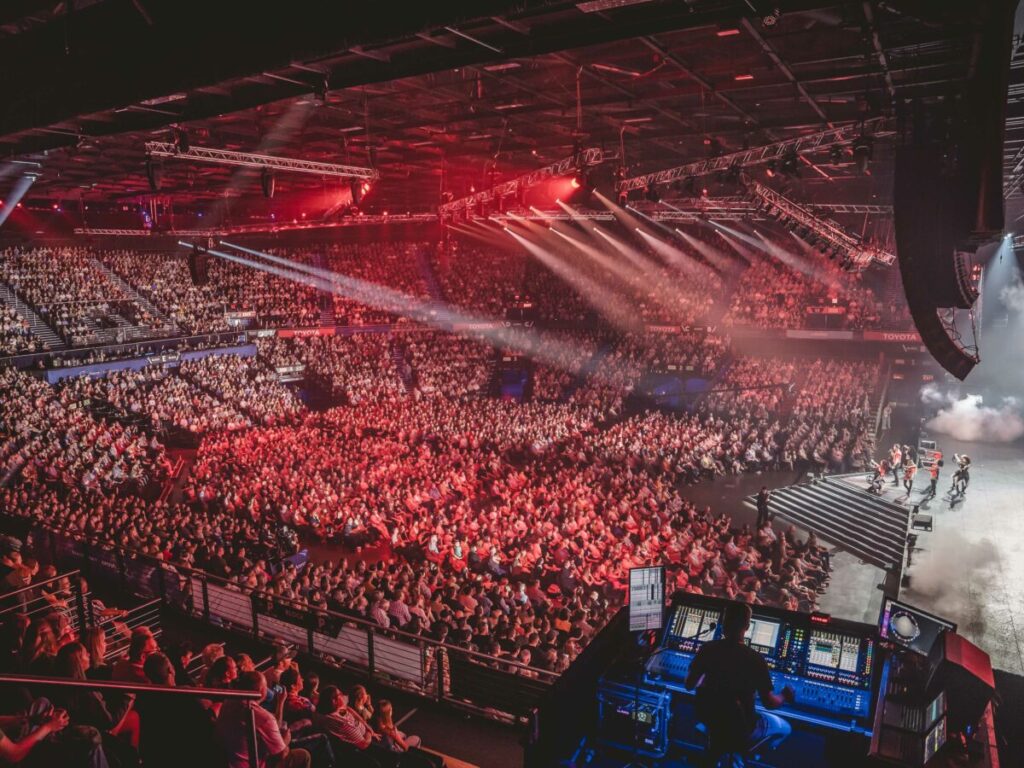
When Chris Brown announced his sold-out concerts in Johannesburg in December 2024, more than 160,000 tickets were snapped up for two nights at FNB Stadium. In 2025, Travis Scott attracted over 90,000 fans to the same venue. Similar scenes have been witnessed at concerts by Burna Boy, Tems, Tyla, Davido, and other African stars performing in Europe and North America.
These events prove one thing: the demand for live music is not the problem.
The real question is why Africa, a continent of more than 1.5 billion people, still has so few world-class venues capable of hosting concerts at that scale.
This is not just an entertainment issue. It is an economic one.

Africa Is Producing Global Stars
African music has never been more influential.
Afrobeats, Amapiano, Bongo Flava, Gengetone, Afro-fusion, and Francophone pop have become global cultural exports. According to Spotify, Afrobeats has experienced explosive growth over the past decade, while artists like Burna Boy, Rema, Tems, Ayra Starr, Wizkid, Tyla, and Asake regularly dominate international charts.
Streaming has introduced African music to millions of new listeners, but it is live performances that generate much of an artist’s income.
According to the International Federation of the Phonographic Industry (IFPI), live events, merchandise, sponsorships, and touring remain among the largest revenue sources for many musicians, particularly in emerging markets where streaming income is relatively low.
Yet Africa’s concert infrastructure has failed to keep pace with the industry’s growth.
Too Few Venues, Too Many Fans
Outside South Africa, Egypt, Morocco, and a handful of countries, Africa has relatively few venues designed specifically for major live entertainment.
Many concerts are held in football stadiums, open fields, hotel conference halls, or temporary event grounds. While these spaces can accommodate large crowds, they were rarely designed for modern live productions.
Promoters often spend enormous amounts transforming these locations into concert venues by installing temporary stages, lighting systems, sound equipment, barricades, dressing rooms, VIP lounges, and power infrastructure.
In many cases, these temporary installations cost almost as much as building permanent facilities over time.
The result is higher ticket prices, greater financial risk, and fewer international tours.
Global Tours Often Skip Africa
One of the biggest frustrations among African music fans is seeing global artists announce world tours that include Europe, North America, Asia, Australia, and the Middle East—but only one or two African countries.
The reasons extend beyond market demand.
International promoters consider venue quality, logistics, safety standards, airport connectivity, accommodation, freight handling, insurance requirements, and technical infrastructure before confirming tour dates.
Without venues capable of meeting international production standards, many cities simply cannot compete.
This partly explains why major international tours frequently stop in Johannesburg, Cape Town, Cairo, Casablanca, and occasionally Lagos, while dozens of other African cities are overlooked.
The Economic Opportunity Is Huge
Concert venues generate far more than ticket sales.
Every major event creates demand for hotels, airlines, restaurants, taxis, ride-hailing services, security companies, event staff, photographers, videographers, caterers, stage technicians, merchandise vendors, and tourism businesses.
According to PwC’s Global Entertainment & Media Outlook, live entertainment remains one of the fastest-growing segments of the global media industry, generating billions of dollars annually.
Cities that consistently host international concerts benefit from increased tourism, business travel, and foreign investment.
South Africa provides a clear example.
Major concerts at FNB Stadium and DHL Stadium generate millions of dollars in economic activity, with thousands of visitors travelling from neighbouring countries to attend performances.
Imagine if similar facilities existed in Douala, Abidjan, Accra, Kampala, Kigali, Dakar, Nairobi, Lusaka, or Yaoundé.
The economic ripple effect would extend far beyond music.
Government Investment Remains Limited
Governments across Africa often invest heavily in football stadiums but rarely in dedicated entertainment venues.
This reflects a long-standing perception that concerts are recreational rather than economic assets.
Yet countries such as the United Kingdom, the United States, and the United Arab Emirates have demonstrated that world-class entertainment infrastructure attracts investment, creates jobs, and strengthens tourism.
Entertainment should not be viewed as a luxury.
It should be recognised as part of the creative economy.
UNESCO estimates that the global cultural and creative industries generate more than US$2 trillion annually and support nearly 50 million jobs worldwide. Africa has the talent to claim a much larger share of that value—but only if it invests in the infrastructure that supports it.
Private Investors Have an Opportunity
Governments cannot shoulder this responsibility alone.
Private investors, pension funds, real estate developers, hospitality groups, and entertainment companies should see concert venues as long-term commercial investments.
Modern arenas are no longer used only for music.
They host conferences, exhibitions, comedy shows, esports tournaments, fashion events, award ceremonies, sporting competitions, religious gatherings, and corporate functions throughout the year.
This diversified business model makes them far more financially sustainable than many people assume.
Cities with growing populations and expanding middle classes present significant opportunities for venue development.
The Future Is Bigger Than Stadiums
The next generation of African venues should be designed with flexibility in mind.
Rather than relying solely on massive stadiums, cities need indoor arenas, mid-sized theatres, open-air amphitheatres, convention centres, and multipurpose entertainment complexes.
Such facilities would support both emerging artists performing before 2,000 fans and global stars capable of attracting 50,000 or more.
They would also encourage year-round cultural programming instead of occasional blockbuster events.
The Verdict
Africa has already proven that it can produce artists capable of filling arenas around the world.
Now it must build the infrastructure that allows those artists to perform consistently at home.
The continent does not lack audiences.
It does not lack talent.
It does not lack ambition.
What it lacks are enough venues designed for the future of live entertainment.
If African governments and investors are serious about growing the creative economy, building world-class concert venues should no longer be viewed as an entertainment expense.
It should be recognised as an investment in tourism, employment, urban development, and one of Africa’s fastest-growing industries.
The next global concert destination should not always be London, Paris, Dubai, or New York.
Sometimes, it should be Douala, Kigali, Lagos, Nairobi, Accra, or Abidjan.

Comments (0)
No comments yet — be the first to share your thoughts.