
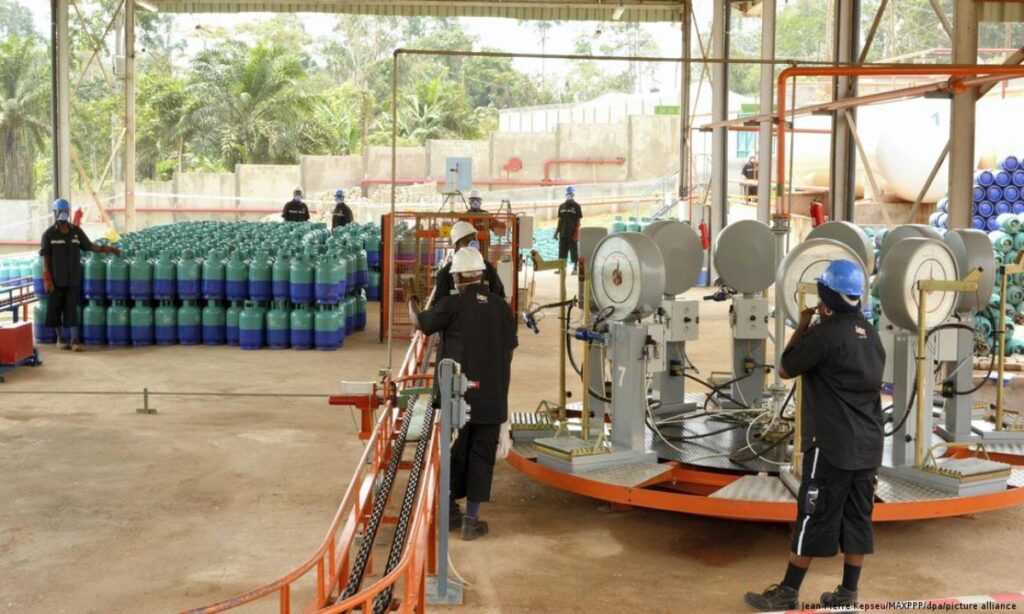
Cameroon is stepping up efforts to ease a persistent shortage of domestic cooking gas, with the government setting a target of 200 tonnes of liquefied petroleum gas, LPG, per day for Yaoundé as authorities attempt to restore regular supplies to households.
Water and Energy Minister Gaston Eloundou Essomba announced the target after inspecting the country’s gas distribution chain, including filling centres and the Société Camerounaise des Dépôts Pétroliers, SCDP, facility in Nsam. The government wants the increased volumes to be maintained for several days so that the market can gradually return to normal.
The intervention comes after weeks of uneven supply across the capital, with some filling stations receiving regular deliveries while others have gone for weeks without replenishment.
Supply Remains Uneven Across Yaoundé.
The shortage has not affected every part of Yaoundé in the same way. Some stations have received new deliveries and are able to sell gas to consumers, while others continue to operate with limited or depleted stocks.

At some locations, deliveries have resumed after periods of shortage. At others, consumers are still being confronted with empty shelves and uncertainty over when the next shipment will arrive.
The uneven distribution has made the shortage particularly difficult for households because the availability of gas can differ significantly from one neighbourhood to another.
For families that depend on LPG for cooking, the disruption has also increased pressure on household budgets, particularly where consumers have been forced to search across different parts of the city for available supplies.
Government Targets 200 Tonnes Every Day.
The latest government response is focused on increasing the amount of LPG entering the market rather than simply responding to shortages at individual filling stations.
In Yaoundé, current distribution capacity is estimated at between 180 and 200 tonnes per day. The minister has instructed operators to maintain the 200-tonne daily target in order to gradually saturate the market and rebuild confidence among consumers.
The government is also relying on private gas-filling companies to contribute alongside the SCDP. The objective is to use all available filling capacity and ensure that gas moves consistently from storage facilities to retail outlets.
In Douala, authorities have set an even higher target of about 220 tonnes per day, reflecting the importance of the country’s largest commercial city to the national petroleum distribution network.
Logistics Remain a Major Challenge.
The government’s inspections have also highlighted logistical problems within the supply chain.
One difficulty is congestion at gas-filling facilities, while the available capacity for transporting LPG by rail has not increased in line with demand. Storage and loading limitations at SCDP have also contributed to delays.
Earlier government directives identified additional problems, including delays in planned imports, payment difficulties involving some market participants and disagreements over the distribution of LPG between household consumers and industrial users.
Authorities have therefore been attempting to address the shortage at several points simultaneously, from imports and storage to transportation, filling and retail distribution.
Households Continue to Feel the Pressure.
The disruption has created an unusual situation in which gas may be available in one part of Yaoundé while consumers elsewhere struggle to find it.
That uncertainty has encouraged precautionary buying, increasing demand at outlets that do receive deliveries and making it harder for the distribution network to quickly rebuild normal stocks.
The government believes maintaining higher daily volumes for several consecutive days can help break that cycle. More consistent deliveries would allow filling stations to rebuild stocks while reducing the pressure created by consumers purchasing gas whenever they find it available.
Can the Higher Supply End the Shortage?
The 200-tonne target is an important test of whether Cameroon can move from emergency responses to a more stable LPG distribution system.
The immediate priority is to keep sufficient volumes moving through the network and ensure that supplies reach households rather than remaining concentrated at storage or filling facilities. But the longer-term challenge is addressing the logistical and structural weaknesses that contributed to the shortage in the first place.
For now, the government is betting on volume. By keeping Yaoundé supplied with around 200 tonnes of cooking gas every day and mobilising private filling operators alongside the SCDP, authorities hope to gradually restore availability and bring an end to the weeks of uncertainty faced by households.
The coming days will show whether the increased supply is enough to return Cameroon’s cooking gas market to sustained normality.

Comments (0)
No comments yet — be the first to share your thoughts.