

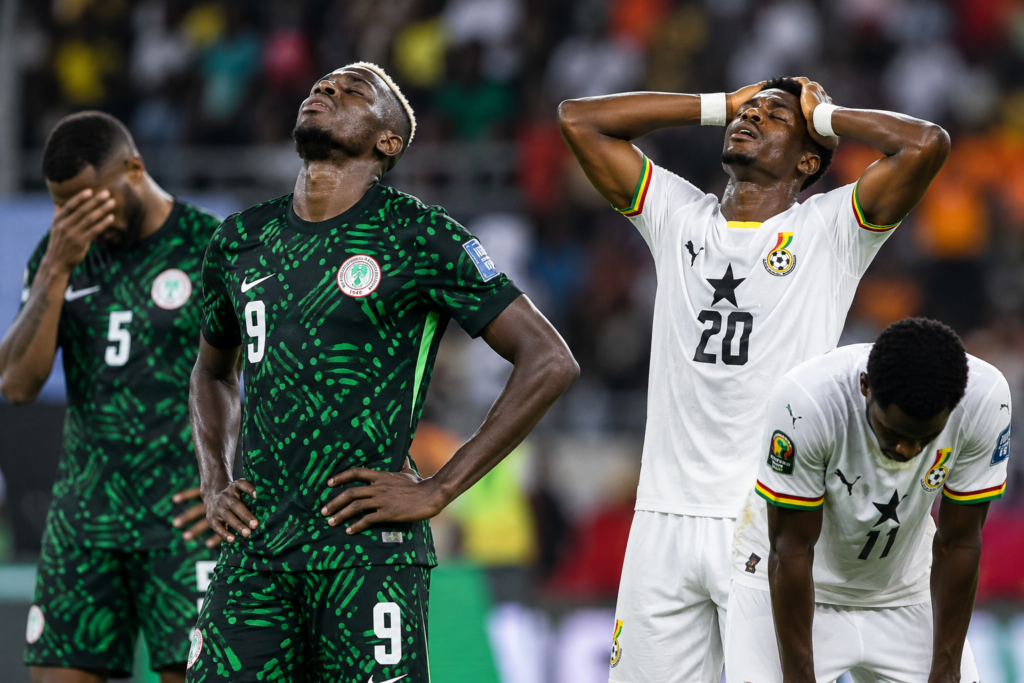
The road to the 2027 Africa Cup of Nations has already produced two major West African shocks, with Ghana and Nigeria suffering heavy defeats in Matchday Two of the qualifiers. Ghana surrendered a two-goal advantage before losing 4-2 to The Gambia in Accra, while Nigeria were beaten 3-0 by Guinea-Bissau in a result that immediately changed the early dynamics of Group L. CAF described both results as two of the standout surprises of the second matchday.
The defeats are particularly striking because both teams had opened their campaigns with victories. Nigeria had beaten Madagascar 2-1 in their first qualifier, while Ghana had entered the second round looking to build momentum after beginning their campaign with a defeat against Côte d’Ivoire. The latest results have therefore created very different situations for two of Africa’s most recognised football nations.
Ghana Let a Two-Goal Lead Disappear.
Ghana appeared to be in control against The Gambia after taking a 2-0 lead, but the match dramatically changed direction. The Gambians responded with four unanswered goals to complete a 4-2 comeback victory.
The result left Ghana without a point after two matches in Group C, putting considerable pressure on the Black Stars as the qualifying campaign moves forward. The Gambia, meanwhile, collected an important victory and strengthened its position in the group.

For Ghana, the nature of the defeat may be as significant as the scoreline. A team that had established a two-goal advantage ultimately conceded four times, turning what looked like a comfortable position into one of the most damaging results of the opening rounds.
The Black Stars are now facing an early qualification challenge in a group that also contains Côte d’Ivoire and other teams still capable of taking points from one another.
Nigeria Hit by Guinea-Bissau.
Nigeria’s defeat was even more emphatic. Guinea-Bissau produced a 3-0 victory over the Super Eagles, securing six points from their opening two matches and moving firmly into control of Group L.
The result was particularly notable because Nigeria had started the campaign with a 2-1 comeback win against Madagascar. CAF reported that Nigeria had recovered from an early deficit in that match through goals from George Ilenikhena and Moses Usor.
Against Guinea-Bissau, however, the Super Eagles could not reproduce that response. The West African hosts turned the match into a convincing victory and handed Nigeria one of its heaviest defeats in the early stages of the qualification campaign.
The result also carries added significance because Nigeria are one of the continent’s traditional football powers and entered the qualifying campaign with considerable expectations.
Guinea-Bissau Seize Control of Group L.
For Guinea-Bissau, the victory represents the continuation of an impressive start rather than an isolated upset.
The Djurtus had already defeated co-hosts Tanzania 2-0 in their opening match. Their victory over Nigeria therefore gives them two wins from two matches and six points at the top of Group L.
Nigeria now face the challenge of recovering ground in a group that includes Guinea-Bissau, Tanzania and Madagascar. With the qualification campaign still at an early stage, the Super Eagles have time to respond, but the margin for further mistakes has narrowed.
The structure of the competition also makes every group match important. CAF has divided 48 teams into 12 groups, with the top two normally qualifying for the finals. Groups containing co-hosts Kenya, Tanzania and Uganda have a different qualification arrangement, with only the highest-ranked non-host nation advancing.
More West African Teams Feel the Pressure.
The Ghana and Nigeria results were part of a wider series of surprises during Matchday Two.
Rwanda maintained its perfect start by defeating Cape Verde 2-1 away from home, while Uganda edged Libya 1-0. Zambia also responded to its opening defeat by beating Togo 1-0.
The results underline how quickly the qualification picture can change. Established football nations cannot assume that reputation or previous tournament experience will translate automatically into points.
The qualifiers are also providing an opportunity for emerging teams to establish themselves against traditionally stronger opponents.
The Road to East Africa Is Still Long.
The 2027 Africa Cup of Nations will be hosted jointly by Kenya, Tanzania and Uganda, making it the first edition of the tournament to be staged across the three East African countries.
CAF has scheduled the qualification campaign across six matchdays, with the next rounds set for November before the final two rounds in March 2027. The tournament itself is scheduled for June 19 to July 17, 2027.
That means neither Ghana nor Nigeria’s campaign is close to being decided. But the opening results have demonstrated just how quickly the qualification race can become complicated.
For Ghana, the immediate task is to recover from two defeats and find points in a difficult Group C. For Nigeria, the priority is to respond to the 3-0 loss before Guinea-Bissau can establish an even stronger position.
The early AFCON 2027 qualifiers have already delivered one clear message: reputation will not guarantee qualification, and both Ghana and Nigeria now have to rebuild their campaigns on the pitch.

Comments (0)
No comments yet — be the first to share your thoughts.