

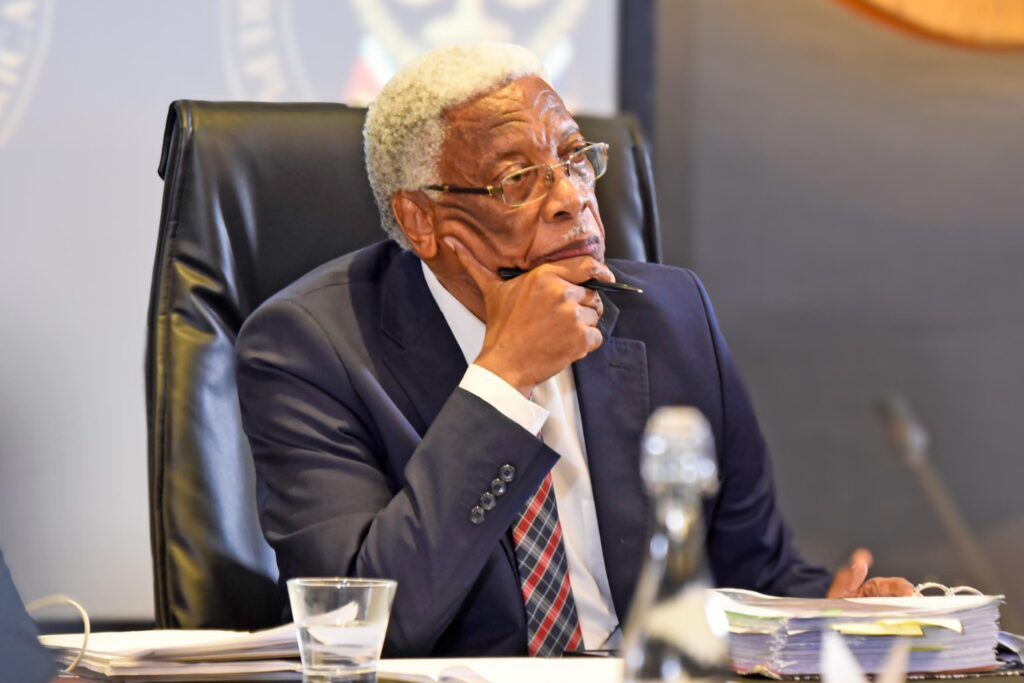
South Africa’s judiciary is facing renewed public attention after the Judicial Service Commission (JSC) recommended the suspension of Judge President Selby Mbenenge of the Eastern Cape Division of the High Court following allegations of sexual harassment.
The recommendation follows an investigation into complaints lodged by a former court employee, who accused the senior judge of sending inappropriate messages and making unwanted advances. Judge Mbenenge has denied the allegations, maintaining that he has acted appropriately throughout his career.
The JSC’s recommendation does not amount to a finding of guilt. Instead, it is intended to protect the integrity of the judicial process while a formal inquiry into the allegations continues.
How the Case Unfolded
The complaint was filed by a former judicial secretary, who alleged that Judge Mbenenge engaged in inappropriate conduct through electronic messages and interactions in the workplace.

Following the complaint, the Judicial Conduct Committee referred the matter for a formal investigation. After reviewing the available evidence, the JSC concluded that the allegations were sufficiently serious to warrant recommending the judge’s suspension while disciplinary proceedings continue.
The recommendation has now been forwarded to President Cyril Ramaphosa, who will decide whether to implement the suspension in accordance with South Africa’s constitutional procedures.
Why the Suspension Matters
Judges occupy some of the highest offices in South Africa’s legal system, making public confidence in their conduct essential to the administration of justice.
Legal experts note that recommending a suspension before the conclusion of disciplinary proceedings is intended to preserve the credibility and independence of the judiciary rather than prejudge the outcome of the case.
The JSC emphasised that judicial accountability is fundamental to maintaining trust in South Africa’s courts.
JSC spokesperson Advocate Sesi Baloyi stated that the judiciary must remain accountable and continue to uphold the highest standards of integrity expected of judicial officers.
Balancing Accountability and Fairness
The case has generated significant public discussion about the balance between accountability and due process.
While many legal observers have welcomed the JSC’s willingness to investigate allegations involving a senior judge, others have stressed that Judge Mbenenge is entitled to a fair hearing and the presumption of innocence until disciplinary proceedings are concluded.
South Africa’s judicial disciplinary system is designed to ensure that complaints against judges are investigated independently while protecting both public confidence and judicial independence.
The ongoing proceedings will determine whether the allegations are substantiated and whether further disciplinary action is warranted.
Implications Beyond South Africa
The case has attracted attention across Africa because it highlights broader questions about judicial accountability and institutional integrity.
Many African countries continue working to strengthen public confidence in their justice systems by ensuring that allegations involving senior public officials are investigated transparently and fairly.
Legal analysts argue that independent oversight bodies play an essential role in demonstrating that no individual, regardless of position, is above institutional scrutiny.
The outcome of the case is therefore likely to be closely watched beyond South Africa.
Public Confidence in the Justice System
A judiciary derives its authority not only from the law but also from public trust.
Cases involving senior judicial figures can affect public perceptions of fairness, accountability and the rule of law, making transparent disciplinary processes particularly important.
The JSC’s recommendation reflects its responsibility to safeguard the reputation of the judiciary while allowing due process to take its course.
Whether the allegations are ultimately upheld or dismissed, the proceedings are expected to reinforce the importance of accountability within one of South Africa’s most important democratic institutions.
What Happens Next
The next stage of the process rests with President Cyril Ramaphosa, who will consider the JSC’s recommendation before deciding whether Judge Mbenenge should be suspended pending the outcome of the judicial disciplinary process.
The formal inquiry will continue independently, allowing evidence to be examined before any final determination is made.
For South Africa, the case represents more than an investigation into one individual.
It is a significant test of the country’s commitment to judicial independence, accountability and the principle that public institutions must remain transparent and answerable to the people they serve.

Comments (0)
No comments yet — be the first to share your thoughts.